News
Latest valve and structural heart intelligence
Filter by Source
Filter by Tag
FDA clears video endoscope for select minimally invasive cardiac surgeries
The FDA has granted clearance for a video endoscope system intended for use in select minimally invasive cardiac surgical procedures. Specific procedural indications and device specifications were not detailed in the available content.
Digest: Enhanced visualization technology for minimally invasive cardiac surgery may facilitate adoption of less invasive surgical approaches for structural heart interventions, particularly minimally invasive surgical valve repair and replacement.
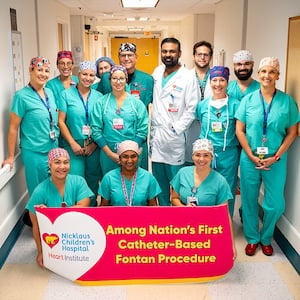
Nicklaus Children's Hospital Performs Transcatheter Fontan Completion on Two-Year-Old Child
Nicklaus Children's Hospital performed one of the first transcatheter Fontan completions in the United States on a 2-year-old child with double-outlet right ventricle, using a catheter-based approach instead of traditional open-heart surgery. The patient recovered well and was discharged home, avoiding additional sternotomy for the final stage of single-ventricle palliation.
Digest: This represents an important expansion of minimally invasive techniques into complex congenital heart disease, potentially establishing a paradigm shift in Fontan completion that could reduce surgical morbidity and recovery time for single-ventricle patients.
Banner Health partnering with physicians to bring more heart procedures to ASCs
Banner Health is partnering with physicians to expand cardiovascular procedures in ambulatory surgery centers. The initiative aims to shift appropriate heart procedures from hospital-based settings to lower-cost ASC environments.
Digest: ASC migration of structural heart procedures could impact reimbursement models and site-of-service strategies as health systems seek cost reduction while maintaining quality outcomes.

Clinical Study to Look at Real-World Use of Transcatheter Edge-to-Edge Repair System for Leaky Tricuspid Heart Valve
Abbott has initiated the Treat TR study, a post-market study enrolling approximately 1,000 patients across up to 100 sites in the U.S., Canada, and Europe to evaluate the safety and performance of the TriClip transcatheter edge-to-edge repair system for tricuspid regurgitation in real-world settings. Patients will be followed for five years, with a sub-study examining the system's potential to reverse cardiac remodeling.
Digest: This large-scale real-world evidence study will provide critical post-market performance data for TriClip TEER, informing adoption decisions and potentially expanding treatment paradigms for TR in clinical practice.

ElectroWire Medical Gets FDA Nod for LightningWire Transseptal Puncture System
ElectroWire Medical received FDA 510(k) clearance for the LightningWire Transseptal Puncture System, a novel electrosurgical guidewire designed to create atrial septal defects for left-sided cardiac procedures. The 0.032-inch diameter system features proprietary insulation enabling low-power transseptal puncture while providing stiffness comparable to 0.035-inch guidewires, with compatibility across existing electrosurgical generators and transseptal introducers.
Digest: This device addresses a critical access step for multiple structural heart procedures including TMVR, LAAO, and atrial fibrillation ablation, potentially improving procedural efficiency and reducing costs through platform-agnostic compatibility.
Less invasive anesthesia strategies during TAVR linked to a key benefit
A study found that less invasive anesthesia strategies during transcatheter aortic valve replacement are associated with improved clinical outcomes. The use of conscious sedation or local anesthesia instead of general anesthesia during TAVR procedures demonstrated a key benefit for patients.
Digest: Anesthesia strategy optimization represents a modifiable procedural factor that can improve TAVR outcomes and potentially reduce costs without requiring changes to valve technology or operator technique.
Heart surgeon makes history, performs first robotic procedure of its kind
A cardiac surgeon performed the first robotic-assisted structural heart procedure of an unspecified type, representing a technical milestone in minimally invasive cardiac intervention. No clinical outcomes, procedural details, or patient data were provided in the available content.
Digest: Robotic platforms may expand minimally invasive options for structural heart procedures, though clinical efficacy and safety data are needed to assess impact on practice patterns.
Cardiologists are first in world to use new leaflet-splitting technique during TAVR
Cardiologists performed the first-in-world transcatheter aortic valve replacement using a novel leaflet-splitting technique. No specific procedural outcomes or patient data were provided in the available article content.
Digest: This first-in-human procedural innovation may represent a new approach to address leaflet-related complications during TAVR, though clinical benefits remain to be demonstrated.
PHOTO GALLERY: Cardiac surgery technologies at the AATS 106th Annual Meeting
A photo gallery showcases cardiac surgery technologies exhibited at the 106th Annual Meeting of the American Association for Thoracic Surgery (AATS). The gallery provides visual documentation of the latest surgical devices and innovations presented at this major cardiac surgery conference.
Digest: Visual documentation of emerging surgical technologies at AATS helps structural heart professionals identify innovation trends and evaluate new devices that may impact surgical practice and compete with transcatheter approaches.