News
Latest valve and structural heart intelligence
Filter by Source
Filter by Tag

FDA approves pediatric pulmonary valve that grows with patients
The FDA approved the Autus Size-Adjustable Valve from Edwards Lifesciences, the first pulmonary valve replacement designed to expand with patient growth, reducing repeat surgeries in pediatric congenital heart disease. The pivotal study of 62 patients aged 18 months to 16 years demonstrated 100% freedom from device-related complications at 30 days, no reinterventions at 6 months, and favorable hemodynamics through 1 year with mean RVOT gradients ≤40 mmHg and less than moderate regurgitation.
Digest: This first-in-class balloon-expandable valve (13-22 mm) with polymeric leaflets addresses a critical unmet need in pediatric congenital valve disease by potentially eliminating multiple open-heart surgeries during childhood growth.
FDA approves first heart valve that grows with children
The FDA has approved the first pediatric heart valve prosthesis designed to grow with children as they develop. This represents a significant advancement in congenital valve replacement, potentially reducing the number of reoperations required in pediatric patients.
Digest: This approval addresses a critical unmet need in pediatric structural heart disease by eliminating the requirement for multiple valve replacements as children grow, which could substantially reduce surgical burden and improve long-term outcomes.

FDA Approves First Heart Valve Designed to Grow with Children
The FDA approved the Autus Size-Adjustable Valve, the first surgically implanted pulmonary valve designed to expand with pediatric growth, featuring novel polymeric leaflets rather than bioprosthetic tissue. The valve can be initially implanted at 13mm diameter for toddlers and balloon-expanded up to 22mm as the child matures, potentially reducing the need for multiple open-heart reoperations.
Digest: This landmark approval addresses a significant unmet need in congenital heart disease management and introduces a novel biomaterial approach that could influence future pediatric valve development across multiple positions.
FDA clears video endoscope for select minimally invasive cardiac surgeries
The FDA has granted clearance for a video endoscope system intended for use in select minimally invasive cardiac surgical procedures. Specific procedural indications and device specifications were not detailed in the available content.
Digest: Enhanced visualization technology for minimally invasive cardiac surgery may facilitate adoption of less invasive surgical approaches for structural heart interventions, particularly minimally invasive surgical valve repair and replacement.

NIH Awards Grant to Help Improve Mitral Valve Surgery Decisions
Mount Sinai researchers received a $3.6 million, four-year NIH grant to develop EVOLVE-MR, a project linking randomized trial data with Medicare records to extend mitral valve surgery evidence to real-world populations. The study will use machine learning and causal inference methods to determine whether clinical trial benefits persist in broader, more diverse patient groups over longer follow-up periods.
Digest: This research addresses the critical gap between clinical trial populations and real-world mitral regurgitation patients, potentially enabling more individualized surgical decision-making for the 13 million U.S. adults with valvular heart disease.
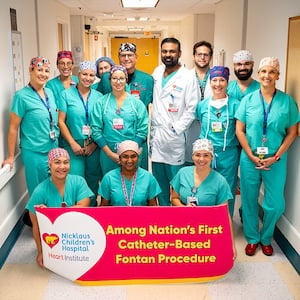
Nicklaus Children's Hospital Performs Transcatheter Fontan Completion on Two-Year-Old Child
Nicklaus Children's Hospital performed one of the first transcatheter Fontan completions in the United States on a 2-year-old child with double-outlet right ventricle, using a catheter-based approach instead of traditional open-heart surgery. The patient recovered well and was discharged home, avoiding additional sternotomy for the final stage of single-ventricle palliation.
Digest: This represents an important expansion of minimally invasive techniques into complex congenital heart disease, potentially establishing a paradigm shift in Fontan completion that could reduce surgical morbidity and recovery time for single-ventricle patients.
Surgeon performs first implant of semi-rigid annuloplasty ring for tricuspid valve repair
A surgeon completed the first implant of a semi-rigid annuloplasty ring for tricuspid valve repair. No additional clinical details, outcomes, or patient data were provided in the source material.
Digest: Represents a technical milestone in surgical tricuspid valve repair, though clinical significance cannot be assessed without device specifications, patient outcomes, or comparative data.
‘This could be transformative’: Surgeon performs first US implant of heart valve still under FDA review
A cardiac surgeon performed the first US implant of an investigational heart valve device that is currently undergoing FDA review but has not yet received regulatory approval. The procedure represents an early access case under what is likely an FDA early feasibility study or expanded access protocol.
Digest: This signals advancement of a novel valve technology through US regulatory pathways and provides early clinical experience that may inform future FDA approval decisions and market adoption strategies.
Tricuspid valve repair linked to major benefits for high-risk heart patients
Tricuspid valve repair demonstrated major clinical benefits in high-risk patients with significant tricuspid regurgitation. The study showed improved outcomes in this challenging patient population undergoing intervention.
Digest: Establishes evidence for tricuspid intervention in high-risk cohorts, supporting growing adoption of transcatheter and surgical repair techniques in an underserved valve disease population.
One New York health system sues another over cardiology services—lawsuit prompts new legislation
A New York health system filed a lawsuit against another health system over cardiology services, escalating competition for cardiovascular care delivery in the region. The legal dispute prompted state legislators to introduce new legislation addressing healthcare service agreements and competition.
Digest: Litigation over cardiology service lines reflects intensifying competition for structural heart programs, which may impact referral patterns, program consolidation, and access to TAVR and other interventional procedures in competitive markets.
Heart surgeon makes history, performs first robotic procedure of its kind
A cardiac surgeon performed the first robotic-assisted structural heart procedure of an unspecified type, representing a technical milestone in minimally invasive cardiac intervention. No clinical outcomes, procedural details, or patient data were provided in the available content.
Digest: Robotic platforms may expand minimally invasive options for structural heart procedures, though clinical efficacy and safety data are needed to assess impact on practice patterns.
Family files $17M lawsuit after young girl’s heart valve allegedly implanted upside down
A family filed a $17 million lawsuit alleging that a heart valve was implanted upside down in a young girl during cardiac surgery. The complaint suggests surgical error resulting in improper valve orientation and subsequent patient harm.
Digest: Surgical valve orientation errors, while rare, represent a critical quality and safety concern that can lead to valvular dysfunction, reoperation, and medico-legal implications for cardiac surgery programs.
Response by Moura-Ferreira et al Regarding Article, “Prognostic Value of Exercise Right Ventricular–Pulmonary Arterial Coupling in Primary Mitral Regurgitation”
This is a correspondence response by Moura-Ferreira et al addressing a previously published article on the prognostic value of exercise right ventricular-pulmonary arterial coupling in primary mitral regurgitation. The response provides commentary or additional perspective on the original research findings regarding RV-PA coupling assessment during exercise in MR patients.
Digest: Exercise RV-PA coupling assessment may refine risk stratification and surgical timing decisions in primary mitral regurgitation patients, particularly those with preserved left ventricular function.
FDA clears first dedicated tricuspid surgical valve
The FDA has granted clearance for the first surgical valve specifically designed for tricuspid valve replacement. This represents the first dedicated tricuspid prosthesis approved for surgical implantation, addressing a previously unmet need in tricuspid valve disease management.
Digest: This approval provides cardiac surgeons with a purpose-built solution for tricuspid valve replacement, potentially improving outcomes compared to off-label use of mitral or aortic prostheses in the tricuspid position.
How to evaluate risk when TAVR patients require surgery later in life
Article discusses risk assessment strategies for patients who previously underwent TAVR and subsequently require non-cardiac or cardiac surgical procedures. Clinical considerations include evaluating perioperative risk in the context of existing bioprosthetic valves and potential complications.
Digest: As TAVR expands to younger, lower-risk populations, understanding how to manage these patients when they need subsequent surgical interventions becomes increasingly important for procedural planning and risk stratification.
PHOTO GALLERY: Cardiac surgery technologies at the AATS 106th Annual Meeting
A photo gallery showcases cardiac surgery technologies exhibited at the 106th Annual Meeting of the American Association for Thoracic Surgery (AATS). The gallery provides visual documentation of the latest surgical devices and innovations presented at this major cardiac surgery conference.
Digest: Visual documentation of emerging surgical technologies at AATS helps structural heart professionals identify innovation trends and evaluate new devices that may impact surgical practice and compete with transcatheter approaches.
Resilia tissue developed by Edwards Lifesciences associated with long-term durability
Edwards Lifesciences' Resilia tissue, an integrity preservation technology for bioprosthetic heart valves, demonstrates favorable long-term durability outcomes. The tissue treatment is designed to reduce calcium buildup and improve structural valve deterioration resistance compared to conventional tissue.
Digest: Long-term durability data for Resilia tissue is critical for structural heart professionals evaluating valve choice in younger, lower-risk patients where extended valve longevity directly impacts reintervention rates and lifetime management strategies.
When bioprosthetic mitral valves fail: Redo surgery bests transcatheter treatment after 5 years
A five-year comparative study found that redo surgical mitral valve replacement outperformed transcatheter valve-in-valve mitral replacement for failed bioprosthetic mitral valves. The superior long-term outcomes of redo surgery over the transcatheter approach challenge current treatment preferences for this patient population.
Digest: This data may influence decision-making between redo surgical MVR and transcatheter valve-in-valve procedures, particularly in patients with acceptable surgical risk and longer life expectancy.
Early SAVR in asymptomatic heart patients linked to long-term benefits
Early surgical aortic valve replacement (SAVR) in asymptomatic patients with aortic stenosis demonstrated long-term clinical benefits compared to conservative management. The study suggests intervention prior to symptom onset may improve outcomes in select patients with severe AS.
Digest: This challenges the traditional watchful waiting approach for asymptomatic severe AS and may influence guideline recommendations regarding timing of intervention in this patient population.

Loneliness linked to increased risk of degenerative heart valve disease
A study published in JAHA found that adults reporting loneliness had increased risk of developing degenerative valvular heart disease, independent of traditional cardiovascular risk factors and genetics. Unhealthy lifestyle behaviors (smoking, excessive alcohol, inactivity) appeared to mediate the association, while objective social isolation metrics (living alone, low contact frequency) were not associated with increased risk.
Digest: This identifies loneliness as a potentially modifiable risk factor for degenerative valve disease, which may inform preventive strategies and patient screening approaches as populations age and structural heart disease prevalence increases.